Showing posts with label life of inger stevens. Show all posts

Wednesday, October 22, 2025

Inger's Friend Robert Redford


Inger and Robert Redford in The Last of the Big Spenders

Inger Stevens considered Robert Redford (1936-2025) a true friend among the Hollywood crowd she encountered. Like Inger, Bob spent considerable time in New York City in the late 1950s and that's where they first became acquainted. He'd studied at the American Academy of Dramatic Arts from 1957 to 1959. They both were dedicated to the craft of acting, turned off by Hollywood phoniness, and drawn to the Broadway stage. Additionally, they were both artists, Bob having studied art at Pratt Institute prior to attending the Academy.

Following his graduation in 1959, Bob auditioned with the Actor's Studio but ultimately found it to be "contrived". He signed with MCA talent agency in 1959, the same year that Inger also signed with MCA to represent her in both her theater and film work.

In addition to his Broadway career, Bob performed in many television shows before becoming a major film star. Although not featured in the same episodes, Inger and Robert made the rounds in the same classic shows: Playhouse 90, Moment of Fear, Route 66, Alfred Hitchcock Presents, The Twilight Zone, Alcoa Premiere, and The Alfred Hitchcock Hour. 

Fortunately, in 1963, the two friends were able to costar in the same television production. The Last of the Big Spenders was an episode of The Dick Powell Theatre that starred Dana Andrews, Robert Redford, and Inger Stevens. In the teleplay, Dana Andrews plays Paul Oakland, an ailing writer who receives a visit from his estranged son Nick (Robert Redford). Nick has a difficult time understanding his father or his father's relationship with the younger woman Adele Hughes (Inger Stevens). A reviewer for The Sentinel wrote, "If you're in the mood for a literate play with interesting characters and absorbing dialogue, this one easily fills the bill. It's almost all talk, but in the capable hands of Dana Andrews, Robert Redford, Inger Stevens, and Herschel Bernardi, it has the quality of a live TV play." 

Here is a clip from the show that I've shared on the Inger Stevens Blog Youtube channel: 

Inger, Robert, and Dana in a LOTBS scene

You can watch the full episode (colorized) through an external Youtube channel:

Colorized LOTBS 

Several years later, Robert Redford was headed for film stardom and shooting interior scenes for Barefoot in the Park. Inger thought it would be funny to surprise him with a gag gift so she imprinted her footprints in a large cement square and decorated the square with palm trees. Inger's secretary Chris delivered the gift to Robert, who cracked up at the sight of it and Inger's ability to poke fun of revered Hollywood traditions.

Chris told biographer William Patterson that Inger was very impressed with Bob's faithfulness to his wife and that, on one occasion, Bob had driven Inger all the way to Palm Springs for dinner, but didn't make a pass. The two had a nice dinner, enjoyed good conversation, then he drove her home. Inger confided in Chris that she and Redford had never been lovers and that she looked up to him as if he were a trusted brother.

Sources:

Callan, M. F. Robert Redford: The Biography. 2014.

"The Last of the Big Spenders." The Sentinel. April 16, 1963. 

Patterson, William. Farmer's Daughter Remembered. 2000.

Sunday, October 19, 2025

Birthdays for Inger


Inger on her 30th birthday in 1964.


A Timeline of Inger's Birthdays


1934: Inger is born on Thursday, October 18th in Stockholm, Sweden.

Inger's entry in the Swedish Birth Index

1953: Inger takes a quick trip back to Manhattan, Kansas, to visit friends on her 19th birthday before returning to New York City

1955: Inger films an episode of Crunch and Des entitled "Salt Water Daffy" in Bermuda. One week shy of her 21st birthday, she writes to a friend about her struggle to find age-appropriate parts:
When I am in the office I must be very mature and businesslike. Here I am twenty, and going to be twenty-one next week, but I have to behave like I'm twenty-eight...then I must dash home and transform myself into a sixteen-year-old (which is getting more complicated everyday) for a theatrical reading. Glamourous one minute and sans makeup, a youngster the next...I wish I could read for a part that suits me. I am not a teenager and I feel terribly uncomfortable when I have to read for teenage parts. For some reason I am not of the young leading type either. I'm what you might call in-between and it's a God-awful fix to be in.
1956: Two weeks before her 22nd birthday, Inger signs a one year contract with Paramount Pictures.

1957: Gossip columnists report that Inger receives a gift certificate for her 23rd birthday from Bing Crosby. Inger sends the certificate as a wedding gift after he eloped with Kathy Grant just six days after Inger's birthday.

1958: Two days after her 24th birthday, Inger is in New York City shooting exterior scenes on The World, The Flesh, and The Devil.

1960: Four days before her 26th birthday, Inger's episode "Pearl Flower" of Hong Kong airs on television.

1961: Inger travels to Boiling Springs, Pennsylvania to appear in the Route 66 episode Burning for Burning. Ike Jones, whom she would soon marry, sends her a telegram to mark her 27th birthday.

With friend George Maharis on the set of Route 66

1963: Inger turns 29 while shooting The New Interns in October.

1964: 30-year-old Inger is celebrated with cake on the set of The Farmer's Daughter. (Photo at top of post.)

1966: A Guide for the Married Man begins shooting six days before Inger's 32nd birthday. Five days after her birthday, Inger appears on The Andy Williams Show.

1967: Inger spends her 33rd birthday in Rome while filming House of Cards.
Inger in Rome in 1967


Sources:
Miller, John J. "Confidential Memo." San Francisco Chronicle. November 24, 1957.
Patterson, William. Farmer's Daughter Remembered. 2000.

Sunday, May 12, 2024

Inger and the Blue Ribbon 400 in 1969

Inger talks to Mrs. Jonathan Larsen at the Blue Ribbon 400 party.

Inger was a member of the Blue Ribbon 400, a group of socialites and celebrities that supported L.A.'s Performing Arts Council. The Blue Ribbon 400 gathered at Mrs. Ingrid Orbach's home for a garden party on Wednesday, June 11, 1969. And who was Mrs. Ingrid Orbach? None other than Swedish actress Ingrid Goude whom Inger posed with for Life Magazine in 1957.

Ingrid Goude (later Orbach), Inger Stevens, and Mai Britt. 1957.

Director George Cukor, actress Rosalind Russell, and actress/dancer Marge Champion gave speeches during the event. In attendance were Polly Bergen, Natalie Trundy, Hope Lange, Shirlee Fonda, and Inger Stevens, of course. The Blue Ribbon 400 aimed for 400 women to pledge to give or raise $1,000 annually to the Los Angeles Music Center. It was revealed during the gathering that the Blue Ribbon 400 had raised over a million dollars to support the arts in less than a year. 

Ingrid Goude Orbach speaks to a guest at the party.

Tuesday, April 23, 2024

Inger at the 1959 Academy Awards

Inger onstage at the 1959 ceremony.

In April 1959, three months after a heavily publicized suicide attempt, Inger made her first public appearance at the 31st Annual Academy Awards ceremony. The event took place at the Pantages Theater on April 6th. Inger's film The Buccaneer was nominated for Best Costume Design, but lost to Gigi. In fact, Gigi dominated the awards, winning nine categories: Best Motion Picture, Director, Screenplay from Another Medium, Score, Song, Art Direction, Costume Design, Color Cinematography, and Film Editing.

Inger participated in an opening dance routine along with Lori Nelson, Jean Wallace, Terry Moore, Carolyn Jones, Erin O'Brien, Arlene Dahl, Connie Towers, Joanna Moore, and Barbara Rush. She also wore costume and hair from The Buccaneer in an onstage fashion show of the year's Best Costume Design nominees. You can view a clip of the fashion show on Youtube.

Inger with other actresses for the opening dance number.

A close-up of Inger from the group photo.

Inger had flown from New York City (where her suicide attempt and recuperation took place) to Los Angeles in early March, which signaled to the press that "her health's O.K. again." Hedda Hopper remarked that Inger was "looking like her old self again" and Inger assured Louella Parsons that she was thinking of the future and that her troubles were behind her. Gossip columnists and fan magazine writers speculated on which married man had caused Inger's anguish and led her to suicide. Several years later, a couple of writers would correctly identify the man as Harry Belafonte. Inger redirected the questions about her personal life to focus on her career aspirations, letting everyone know that she'd love to play Holly Golightly in the upcoming film production of Breakfast at Tiffany's.

Inger was kindly welcomed back into Hollywood. Columnist Sheilah Graham wrote, "Inger Stevens was hard to recognize. The last time I saw her, Inger's hair was a drab shade of blond and she was a worried gal. This time she looked gay, very French with her soft, scattered, very blond and becoming hairdo." 

Bob Thomas wrote that Inger's appearance at the ceremony received an "unusually warm reception...like an outstretched hand of sympathy for a girl who has undergone emotional stress." 

After that welcome, Inger returned to television work. Audiences would see her Inger in Playhouse 90 in May, Bonanza in September, and Sunday Showcase in December. But Inger would not be seen in a movie for another five years. Unhappy with loanouts, bad scripts, and a suspension, Inger surprised everyone by buying out her contract with Paramount by the end of the year. After her contract buyout in December 1959 and before landing the lead role in The Farmer's Daughter series in August 1963, hardworking Inger would star in twenty-two television productions and three plays.

Several years later, Inger would reflect on the year of heartbreak, survival, and independence. She said:

I don’t think I’m the least bit jaded. Life goes on for me in a very happy fashion. I’ve just gone and had, of course, mistakes and certain unhappiness, but that’s all part of it. You can’t be expected to always be making the right decisions. That’s what makes you grow up, and I don’t regret anything. I’m the sum total of all those things. But I know I’ve learned a lot – and changed. I’m more realistic about people now. I don’t think I’m living in a dream world. I don’t expect too much.

Sources:

Buffalo-Courier Express. March 17, 1959.

The Evening Star. April 10, 1959.

The Ledger-Star. April 10. 1959.

St. Louis Post-Dispatch. April 5, 1959.

San Francisco Examiner. March 9, 1959.

Solano-Napa News Chronicle. February 13, 1959.

Sunday, September 24, 2023

Inger Stevens in Sweden (1965)

I had the chance to watch the 1965 documentary Inger Stevens in Sweden in the Library of Congress archives last year. Actually, I watched it twice—once for pleasure and once more for pleasure and note-taking so that I could share a full summary with you. To be honest, I would have enjoyed watching it a thousand times. Some of the photographs from my collection that I'm using in this post are in full color, but the video itself is in black and white. I have added some of my own observations and extra information and placed those in parenthesis throughout the summary.  Following the summary, you'll find behind-the-scenes facts and press responses.

The Documentary

Inger exits a plane and remarks that "the world is smaller than ever. Our understanding between people is more important now than ever before." As she introduces the film, Inger says she was only twelve years old when she left Sweden. (She was actually nine years old when she arrived in America in July 1944.)

Inger takes direction from Don Taylor during filming.

Walking down the cobblestone streets of the old town, Inger says, "People say these streets put their arms around you. I agree." Inger hears the chimes of St. Gertrude and travels down Priest Street. She notices that many of the businesses have closed so that the owners can go fishing and explains that in Sweden, "Time to live is more important than time to make money." Inger then has coffee with a local woman named Vera Siocrona, who helped preserve the town's history. As they sit at an outdoor cafe, they discuss Queen Christina and how she gave away houses to her lovers. On the street, the camera zooms in and Inger humorously reflects on the conservative fashion choices of the male and female residents.

Next, Inger is sitting poolside with boxer Ingemar Johansson outside of a Stockholm hotel. She asks him for his opinions on America and American women. When Ingemar responds that American women are "spoiled", Inger asks "In what way?" "Now you really got me!", Ingemar laughs as he explains that he finds it odd that men must wait for women to exit elevators first and that women expect men to open their car doors. When Ingemar says women shouldn't wait for a man to open the door, Inger smiles and responds much like Katy Holstrum with a Swedish "Ja? Why not?" She lights up and responds, "That's right" about women exiting elevators first. Showing she enjoys American customs, Inger states, "I like that you wait. I mean there are so few nice things left." (A girlish and charming Inger saying "I mean there are so few nice things left" is my favorite line of the film. I cannot tell you how many times I've used it in my own conversations since. I cannot emphasize just how charming, kind, and friendly appears in each of her conversations throughout the documentary.)

Inger and Ingemar talk about American and Swedish customs.

When asked whether he prefers Swedish or American girls, Ingemar answers that Swedish girls are superior. Inger quickly asserts that she is very much a Swedish girl. (Later, Inger would say that she “would’ve preferred to discuss Swedish men but that wasn’t in the script.”) Inger says, "It's wonderful to be back in Sweden...a peaceful feeling. Sweden represents all the inside feelings." Curiously, Inger also shares, "My family is here. I have no family that live in the United States." (Inger, of course, had many relatives including her mother and siblings in Sweden. But she also had a father, stepmother, brother, and half-sister that lived in America. Though she had strained relations with her father and stepmother, it was still shocking to hear her erase her connection to her family in America.)

In the hotel scene with Ingemar, Inger recalls her Swedish childhood. She says that she lived just three blocks from the hotel as a child and thought that the hotel was enormous, too grand for her. She shares that she was more comfortable in the farm and country and always "longed to be up in the woods."

At one point, Inger asks Ingemar if he thinks "In US they say things they don't mean or words become meaningless?" (Inger often brings this point about insincerity up in interviews throughout her career. Typically, she remarks on this insincerity permeating the culture of entertainers.)

Inger waits to shoot a scene.

In the scene that follows, Inger looks at sculptures in MillesgÃ¥rden. (She later remarked, "The day we spent filming there is one I’ll never forget. It’s almost incredible loveliness is difficult to put into words.") Inger then boards a water taxi. The boat's tour guide is sixteen-year-old Peter who works on his summer break. Peter takes a seat by Inger and tells her he would like to become a psychiatrist. Inger asks if he hopes to help people and he answers that he does plus he'd like the money associated with it. The money answer makes Inger laugh. Inger is amused when Peter tells her he has ten girlfriends, all in different locations and unaware of each other's existence.

Inger amused with tour guide Peter's answers

Actor Max von Sydow joins Inger for a car ride to the Royal Palace. We learn that the royal family only lives in the palace during the Christmas season. They stroll through a garden then enter the Drottingholm Theater which Max explains is now "used as storage for a lot of unimportant things." Inger is awed by the theater. As they speak, Inger cannot keep her eyes from taking in the magnificent ceiling, exclaiming breathlessly, "Oh, it's amazing!" (Inger was equally awed by Max, writing in a letter that he was "that kind of man, a Prince Charming, but nothing put on. He is entirely simple, gentle and direct and interested in you. There is a wonderful purity to him. He's terribly sexy, too.")

In a brief transition, Inger can be seen eating a hot dog while wearing an evening gown as she talks about nightlife in Sweden.

In daylight, Inger watches kids play in a park. All the kids gather round as Inger shares a story in Swedish (months before, she had told reporters that she hoped to read a Swedish fairytale) and teaches them to say in English, "I want a drink of water."

Inger visits the workshop of artist Bo Besko. Besko shows Inger his stained glass and they remark that making your own glass is like making pancakes. Inger tells Bo that they have a special connection: Bo's father, when a clergyman, actually confirmed her mother. Inger and Bo take a look at fish being sold from the fish peddler's truck and discuss Sweden's history. They look at a castle's ruins and Bo asks, "You want to keep Sweden the way it is, don't you?" and Inger answers, "Oh, yes."

Inger with Bo Besko

Following the art segment with Mr. Besko, Inger sits down with Prime Minister Tage Erlander who served as the country's leader from 1946 to 1969. They converse about his policies and hope for the future. Erlander states that he regrets Inger left the country and Inger, almost apologetically, relays the oft-told story, "My father received a Fulbright scholarship and went to America. I was only twelve years old." (In truth, Inger's father did come to America for academic study, but the Fulbright scholarship did not exist until several years after his arrival. As mentioned earlier, Inger often changes her age of arrival in America. In this documentary, Inger says that she was twelve. In reality, she was just nine years old.) As she speaks with the Erlander, Inger stands by her decision to remain in the United States, stating, "I think it is very nice that Swedes are all over the world."

Inger in Sweden
Dalarna

Inger explores her home county of Dalarna. Admiring children in traditional garb, Inger trades in her high heels for a pair of wooden shoes. She rides a bicycle through the woods, where, as a child, she learned "the wonder of nature. I loved the sounds and music of the forest." Inger passes a waterfall that she recalls was "her sanctuary" and then enters the school she attended as a girl. In an emotionally moving scene, Inger walks into a small church and recalls Christmas services she attended with her family. She remembers that there was "always an inner warmth, a warmth I'll never forget of the whole family being together at Christmas." The documentary ends with Inger concluding that home will always be Dalarna.

Inger in the Dalarna nature scenes at Lake Siljan.

Behind the Scenes

The shoot was exhausting for Inger. In letters, she wrote of her lack of sleep, that they filmed seven days a week, and that everything seemed to go wrong. Rain ruined much of the shooting schedule and any fun that could have taken place on the weekends. Scenes with Max von Sydow had to be reshot when they realized there had been no film in the camera. Her professional hair dryer mysteriously disappeared from the hotel and a mouse kept her awake.  In letters, Inger wrote:

Life after work is rather normal—shove food down, fall exhausted into bed, get up and sit in the living room since you can't get to sleep and boom!—there's a mouse behind the wastebasket.

Most things that can go wrong have gone wrong, including the worst offense in "filmdom"—no film in the camera. 

It's no wonder that an exhausted Inger was sick with pneumonia as soon as she returned to the U.S. She was a trooper though, calling the situations "exasperating, but you learn to shut yourself off. And when you really boil, hunt for something funny—it's the only saver."

Much of the travelogue focuses on the interesting personalities of the Swedish people. This pleased Inger, who said she felt "more like a peasant girl than a sophisticated American." She said, "I really want to tell about the people. I think some Americans still believe we're going about in costumes at home. We hope to get away from that level if possible."

Inger speaks to her mother upon arrival in Sweden.

Inger had serious reservations about the reception she would receive by her family, who she'd only visited a handful of times since her childhood, and the Swedish people. She said:

I felt a little funny about it, too. After being in America for so long and then coming over to do a special on Sweden—they could have resented that, I think, but they didn't. I cried a little when I saw my mother. Then all the photographers wanted me to cry for them. How do you cry when you have already finished crying?...I was hoping to take my mother to Paris or London on weekends, but bad weather forced us to work whenever the sun came out, so there wasn't any vacation.

While I was walking with Max von Sydow at the old theater the other day, I looked up and saw a young man with two children. He was pushing a baby carriage. "Hey!" I hollered and jumped over a hedge and grabbed him. It was my brother. I've been so busy I haven't had time to see him. He was just on his way to the market and didn't know I was anywhere around. Whenever my family wants to see me, they wander around until they see the lights and they know that's where I am. The other day we were shooting at one of the big squares and a woman came up and said, "Hello, Inger." I didn't know her, of course. She turned out to be a lady who used to be my baby sitter—that is, she sat with me when I was a baby.

The nature scenes in Dalarna included the unique challenge of wooden shoes: 

It is not easy to ride a bicycle in wooden shoes. The guy driving the camera truck didn't know what he was doing and I had to pedal like the very devil and keep up with him and then slow down and smile and contemplate nature and then pump like crazy to catch up again. This went on for four days. 

Also, there was a slight misrepresentation of location in the Dalarna scenes. The scenes of Inger's hometown were filmed in Boda and Tällberg, but Inger actually grew up in Mora, a city in the Dalarna province. Boda and Tallberg are both in Dalarna County but on different points of Lake Siljan. Inger lived in Bromma, Stockholm until 1938 when her family relocated to Mora, Dalarna.

Hometown scenes were shot in Boda and Tallberg,
but Inger actually grew up in Mora.


The Response

The travelogue was a trend at the time and Inger's tour of her homeland followed Jackie Kennedy's White House tour, Elizabeth Taylor's exploration of London, and Princess Grace's tour of Monaco. The documentary was well-received by critics, who deemed it a "beautifully photographed travelogue” worth watching for its “picture postcard views” and “brought to life by the lovely Miss Stevens in short, interesting interviews." Inger was called a "perky guide" and praised for highlighting modern Sweden as equally as its historical monuments.

For me, viewing the TV special confirms several points. One, that my admiration for Inger is reaffirmed (though it was never doubted). The charm and intelligence Inger shows in the varied interviews are unique. Her voice modulates to reflect the wonder, excitement, and warmth she experiences throughout her Swedish exploration. In fact, Inger is so poised and appealing, a person can’t help but imagine her hosting a successful talk show or writing clever bestsellers. She is utterly lovable. 

Secondly, I realize more than ever how isolated Inger must have felt throughout her life. A Swedish girl whose parents left her behind while pursuing their own lives and making new families with other partners. A child pushed from her homeland to be reunited with a father who she'd not seen for years, far away, in a strange country. A child eager to please her father but never able to feel the closeness she desired. A Swedish teenager desperate to shed her traditional, dated clothing to be accepted by her American peers. And, in a matter of years, an independent woman, outwardly American in accent and prospective, traveling back to her European birthplace to visit with family she hadn't seen since childhood. Not wholly belonging in either Sweden or America; not feeling a desired kinship with either parent in their separate places. 

Inger's favorite aspect of filming the show was the positive response she received from the Swedish people. Inger would later say:

The nicest thing about the show for me personally is that when I arrived there the people treated me as one of their own.

Inger in Sweden

Sources:

Daily Press. February 21, 1965.

Inger Stevens in Sweden.  Associated Arts, N.V. ; 1965. Reference print 2 reels : sd., b&w ; 16 mm.

Patterson, William T. The Farmer's Daughter Remembered. 2000.

Portland Press Herald. February 26, 1965.

The Reporter Dispatch. February 26, 1965.

The State February 26, 1965. 

Monday, May 29, 2023

George Maharis and Inger Stevens: An Enduring Friendship

George and Inger during the filming of the
1961 Route 66 episode "Burning for Burning".

When asked about the great actors and actresses he worked with in the past, actor George Maharis listed Inger first. In 2021, Maharis told Rock Goldschmidt of ReMIND Magazine, “I got to work with some wonderful actors and actresses including Inger Stevens, Boris Karloff and Buster Keaton."

George, who recently died at the age of 94 on May 24th, became close friends with Inger after she guest starred in "The Beryllium Eater" episode of Route 66 in 1960. I cannot help but think that Inger would have lived much longer had she possessed more friends as true as George during her lifetime.

George told Inger's biographer William Patterson:

I liked her humanness and warmth. But, at first, she seemed almost afraid of me. Knowing I was a bachelor, she thought that I might be on the make, eager to make a conquest rather than a friend.

George was attracted to Inger's "stubby nose, a crooked mouth, freckles, and listening eyes." Three years after their first episode together (the second would be 1961's "Burning for Burning"), George described Inger as "a marvelous woman, really" and added:

I like Inger. She has a heart as big as the world. I've always had the feeling she needs me. She's the kind of girl who haunts you. You get up in the morning thinking of her and how sweet she is. You want to do things for her. It's a great feeling. Inger and I never went out to fancy places, we just sat around and talked. She's the kind of girl who listens with her big, blue eyes. She gives me the feeling that's she's a sort of trusting child to whom you can say, 'I have four legs,' and she'd believe you. 

George and Inger in the 1960
Route 66 episode "The Beryllium Eater".

After filming "Burning for Burning" in 1961, Inger and George didn't work together again until 1970, but the two remained good friends due to their mutual respect for and understanding of each other. In 1964, George and Inger attended Young Citizens for President Johnson' barbecue party for Luci Baines Johnson in Beverly Hills, California. The photos below show them speaking with Steve McQueen.


George and Inger had many traits in common. As George said after Inger's death in 1970, a major shared characteristic was "falling in love with the wrong people...it's usually harder on a woman, though." 

Both lived without regrets. In 1970, George said:
Everything I do is on the spur of the moment. I've made a lot of rash decisions and mistakes in my lifetime. But I don't regret any of them for one minute. I've never lost any sleep over them. My creed is, do what you think is right, do the best you can, and the heck with it.
Years earlier, Inger shared a similar philosophy:
I hate the word mistakes...I regard life as a series of steps. Maybe I've stumbled on some of those steps. Lots of young people do. But I don't regret it. Everything that has happened to me has helped make me the person I am.
Although both Inger and George valued the artistic rewards of acting, neither were smitten with the business itself. George stated:
I'm only interested in artistic endeavors. The rest you can have. I don't care about business. I don't want to be a millionaire. I tell my manager just to put the money working so people won't tread on me and I won't be a nuisance to other people or to the state when I get old, if I do.
Inger talked about the business of Hollywood, too, sharing:
I was afraid of the people who were handling me at the time. They gave me so much advice contrary to my own ideas...The more I tried to follow their advice, the less inner peace I found.
This town has a tendency to swallow you up...Sometimes people here do everything for the mythical career. Some people sacrifice everything to get on top of the heap. They sacrifice friendship, their own individuality, and become a slave to a career.
Like George, Inger, in 1969, insisted she would never be a nuisance to others. She said:
They'll never hold a benefit for me. And the only reason I'll ever go to the motion picture country home is to entertain the old timers out there.
To maintain privacy surrounding their individual romantic lives, George and Inger cited their busy work schedules on popular television shows.

George answered why he hadn't settled down by stating:
This TV series has given me countless opportunities for that sort of thing but the heavy work schedule, the constant moving around have prevented me from doing very much about it.
Though she was already married to Ike Jones at the time, Inger responded:
Yes, I want to get married, but it will take a very special understanding man to put up with my schedule. I have to be up at 5 a.m. to leave for the studio, and I usually don't get home until 8:20 at night. I never have a day off in the series, and when I do, I have to shoot commercials or photographs.
If they found themselves hemmed in by their public images, Inger and George turned to painting as an outlet of free expression. 

Inger commented:
I like to paint for relaxation. I think the reason that actors and actresses paint is that it's the one thing that they can do that other people really don't tamper with.
George echoed this sentiment in 2021:
I have always loved painting, as you are free to do what you want to do. Just me, the paint and the canvas!

In 1970, after starring in Aaron Spelling's television movie Run, Simon, Run, Inger signed on to costar with George Maharis and Ralph Bellamy in the forensic crime drama Zig Zag (soon renamed The Most Deadly Game). Inger and George worked together preparing promotional videos of the show in the months leading up to her death. 

George recalled learning of Inger's death:

I heard about it at home. Aaron Spelling phoned me. Inger had appeared to be in good spirits, in good health. We had had several conferences on the series. We had just made some promotional films together. It was a great shock...Inger was a personal friend of mine. I loved her and the idea of working with her. We both liked all the elements. It was going to be a great combination. 

After Inger's death, the female lead in The Most Deadly Game was played by Yvette Mimieux and the show did not last its first season. Though we were robbed of watching Inger and George costar once more, the promotional video still exists. 

Zig Zag (1970)

Zig Zag (1970)

Zig Zag (1970)

Thank you, Mr. Maharis, for the indelible mark you left in the world of television and movies. Thank you for enhancing the soundtrack of the 1960's with your smooth, swinging recordings. Thank you most of all for treating our Inger with the kindness and respect she deserved from all of her peers and for continuing to speak her name and share her talents until the end of your life.

Sources:

Boston Globe. October 4, 1970.
Cincinatti Enquirer. October 23, 1970.
Daily News. December 18, 1960.
Miami Herald. August 26, 1962.
Orlando Evening Star. July 3, 1970.
Photoplay. January 1962.
San Francisco Examiner. July 26, 1970.

Wednesday, April 26, 2023

Harry Belafonte (1927-2023)


As a stage talent Harry Belafonte was a tremendously gifted artist, arguably one of the greatest actors of his generation. But as we celebrate his entertainment career and civil rights advocacy, we should remember, at least on a page devoted to the life of Inger Stevens, that the icon was also an imperfect man capable of poor decision-making and hurtful actions. It was the imperfect man that Inger fell in love with on the set of The World, The Flesh, and The Devil in the spring and fall of 1958. During their romance, Harry even met Inger’s mother Lisbet in Sweden, inviting Lisbet backstage where he kissed her hand and bowed to her after a concert. At the time, Inger was a young, single woman isolated in New York City, a city that held traumatic memories for her. Harry had recently married (his second, to Julie Robinson in 1957) and had a new baby at home. 

Inger told friends that Harry promised to leave his wife and marry her. She was devastated when Harry suddenly withdrew from her and his promise following the end of filming in November. In December, a shattered Inger embarked on a busy, multi-city tour to promote The Buccaneer. Though she put on a brave face and a big smile during the contractually-obligated promotion, a photo taken in frigid Minnesota on December 6 captures Inger’s sadness. 

Inger on December 6, 1958

Less than a month later, as others celebrated a new year of new opportunities, Inger attempted to take her own life. Though she didn’t publicly divulge his name, Inger, after recovering from the attempt, did tell the press that hopelessness and loneliness following a failed romance were to blame. Privately, Inger confirmed that the failed romance was with Harry. How disappointing it was then, in 2011, to read Harry’s autobiography and find that he wrote nothing about his romance or even a close friendship with Inger after all these years. A paragraph or two naming Inger as his costar with a few details about the frustrations he had with the movie’s script was all that he shared. 

As a blog dedicated to sharing the truth of Inger’s life, we would be remiss to exclude her personal connection to Harry. Inger was the first person to admit her own flaws and mistakes. She also knew that being labeled a star could be a tricky thing. In 1964, Inger said, “What is a movie star? I have never really known what a movie star is. I know what a star in the heavens is, but not a movie star. The star I think of is the one who has a lot of french poodles that surround her and keep her from functioning as a human being. The work is what should count.” 

Let’s count Harry’s talented work and many contributions, but burying the reality that he functioned as a flawed human being (hurting Inger and others along the way) benefits no one. This week also marks the 53rd anniversary of Inger’s tragic passing, on April 30. As you remember Harry this week, we hope you’ll also remember the often unremembered Inger and the considerable life she lived in her brief years on earth.

Saturday, January 21, 2023

In Inger's Footsteps

Welcome to a virtual tour of notable Inger places. This list is just a small selection as there are more Inger-related adventures and discoveries to come.

8000 Woodrow Wilson Drive, Los Angeles

The Hollywood Hills home that Inger shared with her husband Ike Jones is located at 8000 Woodrow Wilson Drive in Los Angeles. Inger lived at this property from 1963 until her death in 1970. According to Zillow, the 2620 square foot home was built in 1948, includes two bedrooms and two bathrooms, and sits on almost half an acre. 

Inger was proud of her home, sharing decoration and style tips with the press in 1969. You can read an earlier blog post that includes that article here. It was inside this home that Inger spent her final moments on April 30, 1970.

Below are pictures of the house from my visit in 2021.

The mailbox at 8000 Woodrow Wilson


The home and garage in December 2021.
A major landscaping project was taking place.

The front fence and garage

The garage

Inger inside 8000 Woodrow Wilson in 1969

The house and garage as it looked on the day of Inger's death.
Policemen and newsmen stand outside.

1355 North Laurel Ave, West Hollywood

Built by the Davis Brothers in 1927, the luxury apartment building currently includes 11 separate residences. Inger lived at this location in 1959 as she was filming her memorable appearances in Twilight Zone and Bonanza, among others. Silent film actresses Theda Bara, Mabel Normand, and Pola Negri lived at this address in the 1920s. 

Although I'm not certain when she moved, Inger was living at 1619 3/4 North Martel in Los Angeles by summer 1961.


The Laurel Ave address is listed on Inger's November 1959
passenger record following a trip to Colombia by way of Panama.


Inger lived in an apartment at this location in 1959.

My phone photos above don't do the gorgeous place justice,
so here's a more impressive photo from the Trulia website.

A view of the entrance with front fountain from the Trulia website.

648 Midvale Avenue, Los Angeles

After being signed by Paramount Pictures, Inger lived in a condo at 648 Midvale Avenue in Los Angeles in 1956. Filming on her first motion picture Man on Fire began in December of that year.

View of Inger's Midvale residence in December 2021


A daytime view of the Midvale residence

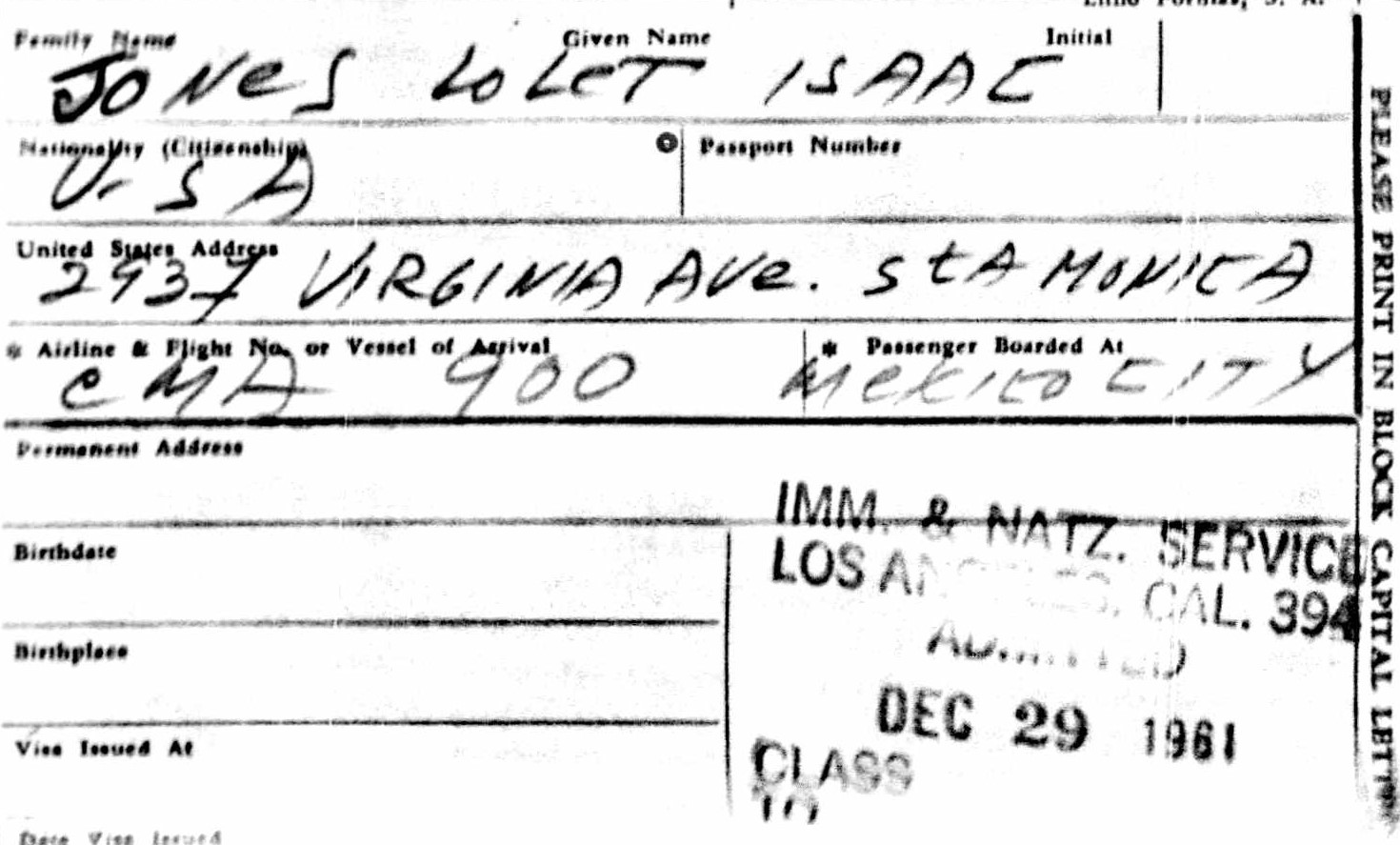
2937 Virginia Avenue, Santa Monica

While he was enjoying a secret honeymoon with Inger in Mexico in late 1961, Ike Jones (born in Santa Monica in 1929) listed his home address as 2937 Virginia Avenue in Santa Monica. Though Inger didn't live in this home, she certainly spent time with Ike there during the early stages of their relationship. 

On his return trip from Mexico City, newlywed Ike Jones notes
the Virginia Ave address on this travel document.

My sad photo of Ike's home is all tree and shadows...

But this photo found online shows Ike's home in the proper light.

Ike Jones, at age 22, in 1952. He would meet Inger 8 years later.

Santa Monica Civic Auditorium

Who could forget Inger's mini-dress at the Academy Awards? The one that helped get miniskirts banned at the following year's Oscar ceremony? (You can read about it in this earlier post.) The ceremony took place at the Santa Monica Civic Auditorium on April 10, 1967.

Unfortunately, the area was unsightly due to construction when I took my photograph, but look how it shines with a happy, stunning Inger in front of it!

The auditorium in 2021

Inger in front of the auditorium in 1967

SMCA entrance now and with radiant Inger then


Inger (in color!) in front of the auditorium

The Holiday Theatre

Inger made her Broadway debut in a play fittingly titled "Debut" in February 1956. The play closed in a matter of days, but Inger had a sense of humor about the flop, telling Louella Parsons, “I was on Broadway for six months without actually being there. I opened in a play at the Holiday Theatre called Debut. It lasted four days and was a dismal failure. The theatre closed, but my name remained in lights on the marquee until the theatre reopened six months later." 

The Holiday Theatre was built in 1918 at 1567 Broadway. It is now the site of Dos Caminos, which you see directly behind the car. Below is a photo I took in 2021.

Site of the former Holiday Theatre where Inger's
name remained up in lights in 1956.

Inger on stage at the Holiday Theatre. Source: NYPL

Cort Theatre

"Roman Candle" premiered at the Cort Theatre on February 3, 1960. Like "Debut" four years earlier, "Roman Candle" closed after only 5 shows in 3 days, on February 6. Although disappointed, Inger joked about the failure, saying "At least I'm consistent!"

I visited the Cort when it was under construction in 2021. Built in 1928, the Cort is located at 138 W. 48th Street. 

An Inger fanatic under the Cort sign

Inger on stage at the Cort, 1960. Source: NYPL

D.C.

In 2022 I traveled to Washington, D.C. after making appointments to view Inger Stevens in Sweden (1965) and Strangers in Hiding (1954) in the Library of Congress archives. Watching two rare Inger appearances in the quiet, cold archives was a dream fulfilled. In fact, I was so wrapped up in the afterglow of seeing Inger footage that I failed to take photos of Katy Holstrum's D.C. once I emerged from the library.

In the archives with Inger

My sole reason for making a trip to D.C.

Inger in D.C. for The Farmer's Daughter