Showing posts with label magazines and newspapers. Show all posts

Friday, April 1, 2022

The Farmer's Daughter Wedding Episode

Inger rests on a slant-board as not to wrinkle
Katy's wedding dress.
Source: TV Guide. October 23, 1965.

As she prepared for a long day of filming the long-awaited wedding of Katy Holstrum, Inger felt jittery:
I'm so nervous you'd think it was the real thing. I had a hard time sleeping last night and was at the studio before 6 o'clock this morning. I had nightmares of tearing the dress or dropping coffee on it. I'd certainly like a tranquilizer. But I really think they want me to be nervous.
Director Bob Claver agreed, "We want you to be a trembling bride for the camera."

Inger said that she was surprised that "all of us could be so nervous...I'm disgusted with myself." Upon seeing her stylist and costumer tremble while placing the tiara on her head, Inger joked, "You two are worse than I am. Here, let me help."

Even actor Walter Sande (Papa Holstrum) admitted that rehearsing the walk down the aisle was emotional for him, because of his love for Inger:
Once more and I'm afraid I would have cried. My emotions kept building. This is strange for an actor, but I love that girl so much.
The only actor seemingly unfazed by the affair? Bill Windom appeared cool and completely at ease throughout the filming.

Sleepy Bill during rehearsals.
Source: TV Guide. October 23, 1965.

Inger and Bill chat over hair and makeup at 6 a.m.

The television wedding cost the studio approximately $75,000, including a purchase of 40 bags of rice. Costume designer Joie Hutchinson rightly selected Autumn-appropriate dresses for the maid of honor and bridesmaids since the wedding was set to air in November; however, in July when the episode was filmed the actresses were overly warm in velvet tops, satin skirts, and petal headdresses. 

Inger does a final makeup and hair check.

Inger and Cathleen Nesbitt behind the scenes.

During filming, actress Elizabeth Montgomery walked over from the Bewitched set to congratulate Bill and Inger. Real wedding presents arrived for the fictional bride! Inger received an album of classical flamenco guitar recordings from actor David Lewis, who knew of Inger's interest in guitar. Inger also was gifted the set of engagement-wedding rings she wore in the series.

According to Eddie Foy III's original Day Out of Days schedule for the show, the cast and crew rehearsed for the episode (production #3807) on July 26 before filming for four days from July 27 through July 30, 1965. 

A beautiful bride

Inger seemed excited about the possibilities a marriage might bring to The Farmer's Daughter,  stating: 
I hope we will be able to show that a married couple can be sophisticated—yes, and even sexy. After all, he found her attractive and appealing enough to marry her. Why should we try to hide their love just because they're married?

Inger knew that network television was perhaps still not ready to be too sexy. After all, in the honeymoon episode William Windom's character was allowed to say he asked for double accommodations, but not a double bed. Inger commented:

The use of the word 'bed' was absolutely forbidden. It looked as if the show would have to be abandoned. But he was allowed to substitute 'accommodations' with only a glance at the bed. If the audience wants to read something into the glance, it may.

Inger was also looking forward to donning a new wardrobe in the third season:

Katy wears more sophisticated clothes now and her hair is shorter and more stylish. I think that's only natural. It shows that he has an effect on her.

A shot of the making of the wedding scene.

"To Have and To Hold" was certainly one of the most anticipated and celebrated television events of the season. Yet the network and sponsors' interest in the show appeared to be waning even before the wedding episode aired.  The episode, already heavily promoted to air Monday, November 1, was postponed the week of airing when The Farmer's Daughter was suddenly switched from Mondays to Fridays—reportedly to give Peyton Place a more advantageous time slot. The wedding would air on Friday, November 5. You can watch the full episode on Youtube thanks to the William Windom Tribute Site by playing the embedded video below or clicking here.


There were also reports that Clairol, the show's main sponsor, was ready to pull out at the end of season two, but maintained sponsorship after Screen Gems VP John Mitchell promised to marry the lead characters and uniquely promote the event in season three. That unique promotion took the form of a party hosted by former ambassador, noted socialite, and later television host Perle Mesta.

Inger in a promotional shot from Screen Gems.
Source: Scan from my collection


Host Perle Mesta smiles as Inger feeds William Windom
a slice of wedding cake.
Source: Pittsburgh Press. November 2, 1965.

The studio's last minute switch in airing "To Have and To Hold" four days late caused a bit of a headache for party host Perle Mesta since the party was scheduled to take place in conjunction with the premiere on Monday, November 1. The plan was to screen "To Have and To Hold" and then guests would greet "Mr. and Mrs. Morley" and enjoy a wedding cake. Mesta shrugged off the switch saying the party, which took place in Mesta's penthouse complex overlooking the Washington Monument, was "all just for fun anyway." Over 100 people, including ambassadors and officials, attended the party where they danced, drank pink champagne, and ate wedding cake.

Inger arrived at the party wearing a gold dress, with scooped neckline, covered in white beads. Mesta told reporters that she "nearly dropped over" at Inger's congeniality; Inger requested the guest list before the party, memorized facts about each guest, then showed up able to chat personally with each person.

Although the Holstrum-Morley wedding brought new publicity to the show and is still a beloved television event to viewers today, it proved not enough to save the show long-term. By the end of the third season, the show's plot grew stale for viewers and the network didn't seem willing to revive it. Inger saw the end of the show as an opportunity to re-enter films and enbraced portraying a variety of characters again. You can learn more about The Farmer's Daughter on my TFD page by clicking here.

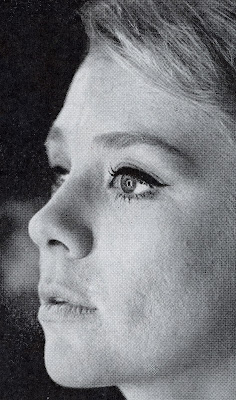
Finally, I'm including this shot of Inger because I love her profile (even in a bad quality newspaper picture) and it was included in an article about the fictional nuptials.

Inger.
Source: Indianapolis News. February 20, 1965.

Sources: 
Beale, Betty. “Picked Up Tab, Perle Insists.” The Pittsburgh Press. November 14, 1965. 
Lanahan, Frances. Perle Packs Them In-Wedding or No Wedding.” Rapid City Journal. November 5, 1965. 
Leonard, Vince. “Perle Hosts ‘Farmer’s Daughter.’ The Pittsburgh Press. November 2, 1965. 
Lowry, Cynthia. "Farmer's Daughter Wedding a Bit Shaky." Dayton Daily News. August 7, 1965. 
“Perle Rises to Occasion of Make-Believe Vows.” The Wichita Eagle. November 3, 1965.
Thomas, Bob. "Inger Stevens to be Sexy in New 'Farmer's Daughter.'" Hattiesburg American. October 2, 1965. 
Thomas, Bob. "Katy, Morley To Get Married?" The Indianapolis News. February 20, 1965.

Wednesday, March 9, 2022

Inger Stevens: Lions Bowl Queen

Inger, Lions Bowl Queen, waves
during the 1965 Christmas parade.
Source: Santa Maria Times.

It was announced via the Santa Maria Times on November 27, 1964 that Inger Stevens would serve as the first queen of the Lions Bowl Junior College football game at Dave Boyd Field on December 5, 1964. The game was sponsored as a benefit for Santa Maria Council for Retarded Children and Inger, as the California Council for Retarded Children’s honorary chair, gladly participated.

Inger arrived in Santa Maria, California, on Friday, December 4th. The following morning Inger was in place as parade entry #6 in the Santa Maria Christmas parade, which featured eight bands and approximately thirty-five floats/cars. In the parade route, Inger followed Harrel Fletcher and Lane Bryant, co-chairmen of the RMA Christmas Committee and she preceded pageant princesses from the local schools.

The Coalinga Falcons beat the Santa Barbara City College Vaqueros with a final score of 41-19 at the game later that day. Inger made a special appearance during the half-time show where she was formally presented the title of Lions Bowl Queen of 1964. A month later, Santa Maria Times reported that a check for $1,125.75 was presented to Dorothy Bell, president of the Santa Maria Council.

Inger speaks to the crowd at the
1964 Lions Bowl festivities.
Source: Santa Maria Times.

Inger was named as Lions Bowl Queen a second time the following year and appeared at the second annual Lions Bowl on December 3-4, 1965. On Friday, December 3rd at 7:00 p.m., Inger attended a cocktail party at Iversen Motor Company, which fully benefited the Santa Maria Council. Inger mingled and signed autographs. The following day Queen Inger rode in the morning Christmas parade (see photo of Inger in the '65 parade at top of this post.) Later in the day, Inger appeared at the game at Dave Boyd Field where she witnessed Harbor College beat Reedley College with a final score of 51-16. Though Inger didn't make a fuss, there was some embarrassment for the Noontime Lions Club when they realized a member forgot to give Inger a bouquet of flowers during the half-time presentation.

Inger uses Lions Club President Al Hall's back
to sign autographs during the 1965 cocktail party.
Source: Santa Maria Times.

Inger frequently filled her weekends with work as the honorary chair of the California Council for Retarded Children (also known as the CCRC). In addition to publicity and charity opportunities arranged by the statewide and local councils, Inger initiated and hosted a series of celebrity art shows to benefit children. As early as 1963 Inger promoted the English translation of aunt Karin Stensland Junker's book The Child in the Glass Ball—a story of Karin's journey as a mother to two children with intellectual disabilities. 

Inger proudly shows aunt Karin's book
The Child in the Glass Ball.
Source: scan from my collection.

Inger not only served as honorary chair of the CCRC, but also volunteered much of her free time with children at the Kedrin Community Health Center and joined the Advisory Board of the Neuropsychiatric Institute at UCLA. One month before her death, Inger stated that the work she completed with the Institute and the Council was the most fulfilling work of her life.
Inger with a child in her work with the CCRC.
Source: Original Jerry Lem site/Darrell Short


Inger's 1966 appointment to the Advisory Board
of Neuropsychiatric Institute.
Source: Original Jerry Lem site.

Sources: 
“Bowl Queen in Parade.” Santa Maria Times. December 4, 1964. 
“Coalinga Wins Lions Bowl game, 41-19.” Santa Maria Times. December 7, 1964. 
“Harbor Stuns Reedley in 51-16 Lions Bowl Route.” Santa Maria Times. December 6, 1965 
“Inger is Lions Bowl Queen.” Santa Maria Times. November 24, 1965.. 
“Lions Bowl Proceeds Presented.” Santa Maria Times. January 14, 1965. 
“Lions Bowl Queen.” Santa Maria Times. November 27, 1964. 
Oppenheimer, Peer J. "Inger Stevens Says: 'I Can't Live Only for Myself.'" Family Weekly. March 8, 1970.
“Parade Officially Opens Christmas Shopping Time.” Santa Maria Times. December 4, 1964. 
“Santa Claus Comes to Town.” Santa Maria Times. December 4, 1965. 
“Signature from a Star.” Santa Maria Times. December 4, 1965. 
“Vaqueros Prep for Lions Bowl.” Santa Maria Times. December 2, 1964.

Tuesday, March 8, 2022

Take Me to the Fair: Amusement Park Pictorial

In its January 1965 issue, Movie Life magazine featured a pictorial of Inger letting loose at a local amusement park. Obviously staged publicity during the run of The Farmer's Daughter, the editors spun the story as Inger, upon hearing her show's director yell "Cut!", rushing "out of the Screen Gems' parking lot and onto the open road...For a brief hour Inger took her pert nose off the grindstone and poked it into a world of fun. She raced on the merry-go-round, walked barefoot, ate cotton candy. Unwound. For a gal who believes in a firm 'no trespassing' sign on her private life—this was a rare occasion, allowing us a personal glimpse of a wistful, wondrous Inger Stevens."


Sources:

All photos are scans from my magazine collection.

"Off Limits." Movie Life. January 1965.


Monday, March 7, 2022

Inger on the Advantages and Disadvantages of Beauty

Inger in TV and Movie Screen, August 1964.

When asked by fan magazine writer M.P. Todd what it felt like to be beautiful, Inger responded:

You sincerely meant that last compliment, didn't you? I could tell. So I'll give you a serious answer. Today I never think about how I look. Maybe it's because for too many years I thought of myself as ugly. You know the type. I had straight hair, teeth that went in all directions, and I was the shape of a string bean that had been left out in the sun too long. By the time I grew up to look like what I am now, I had already developed the feelings inside of a girl who does not consider herself pretty. I'll tell you a secret, if I am attractive today it is because my face—all of me on the outside—reflects an inner security I have never possessed before. 

What was it like as a girl being treated like a Hollywood beauty? Inger shared:

At first, the attention, the compliments are wonderful. Later, often too much later, the beauty discovers that people, especially males, flocked around her mainly because it gave their egos a boost to be seen with her. At first, innocently, the beauty trusts too much. She believes all the excess adjectives. She delights in all the conquests  she makes merely by existing. But then it begins to catch up with her. If, along the way, she hasn't taken the time to develop her mind, her personality, her character, then she usually winds up alone. She's confused. Unable to cope with the situation. She becomes bitter, miserable. She realizes all too late that she's been used like a pet—a toy—to be exhibited then put back on the shelf. 

Perhaps that's why I searched so long to try and find the right way for me to live my life. There was a period where I, too, received and reveled in the flowery adjectives and the phony attention that actually wasn't directed at the real me but at what my surface supposedly represented. When I finally understood—it was a painful period. I won't discuss it, except to tell you that that I finally hit upon a solution. Now I don't allow myself to rely or depend upon outside words of praise from others. This leads only to self-deception and pain, believe me. Today I have learned to rely only on myself to judge my own true worth. I see my weaknesses and I try to correct them. I see my strengths and I try to preserve them. 

Source: 

Todd, M.P. "A Brand-New Inger Stevens." TV and Movie Screen. August 1964.

Tuesday, October 26, 2021

Indomitable Inger and Her 'Post' Remarks


In early 1964, Richard Warren Lewis wrote a two-page feature on Inger that primarily focused on the challenges Inger had faced in her life up to that point. 

On her family:

I witnessed an awful lot of fighting in my family. I got used to keeping things to myself and never really saying what was on my mind. I was always afraid of hurting somebody.

On her 1955 marriage to agent Anthony Soglio:

[The wedding day] was the worst day of my life. I wanted to be anyplace but where I was. I married him for a lot of the wrong reasons. I had been dating him for about eight months, and he was the only person I knew in New York. For me the whole marriage proved pretty much of a nightmare. The experience made a lasting impression on me. I still have a fear of marriage.


On her 1959 suicide attempt:

It was such a relief. At that moment I thought it was the most rational thing I'd ever done in my life. For a long time I had nobody to talk to, including the man I had been with. When I began trusting the analyst, everything came out too fast. I felt lonely and sorry for myself. I felt like I didn't quite belong in the film world, that I wasn't good enough. I was constantly getting depressed. I had made a complete mess of my emotional life by trying to be very giving to a man because I was hoping he would do the same to me. I was just screaming out for somebody to love me. I kept searching for some kind of peace and tranquility. The more I searched for it, the more holocaust there was around me. It kept getting worse. [At a New Year's Eve party] Everyone was drinking, and it became more and more depressing. Everything seemed so distorted. I felt I was on the outside looking in. All of a sudden there was only emptiness. I needed someone to talk to, but there was no one left. Then everything exploded.

On her personality:

Once I felt that I was one person at home, and the minute I stepped out the door I had to be somebody else. I had a terrible insecurity, an extreme shyness, that I covered up with coldness. Everybody thought I was a snob. I was really just plain scared...I always used to jump into friendships and give too much. You can't do that. You end up like Grand Central Station with people just coming and going. And there you are, left behind...Sometimes I wonder if being an actress is really going to be enough for me. When you're sixteen, being in show business is a very romantic notion. You dream about your pictures all over the magazines. But what you think at sixteen and what you think at twenty-nine are two different things. If I took a test, I would probably find I'm in the wrong field.

In his biography of Inger, Patterson wrote that Inger, upon learning a new word, would write the word and its definition on an index card. On the back, she would use it in a sentence. On an index card for the word 'indomitable', Inger wrote:

Inger is indomitable because of her courage and her pride.

The Oxford English Dictionary (personal sidenote: Hi, Chuck!) defines 'indomitable' as:

1. That cannot be tamed; untameable.

2. Of persons, etc.: That cannot be overcome or subdued by labour, difficulties, or opposition; unyielding; stubbornly persistent or resolute.

From her earliest days in America, attempts were made to tame Inger. A father and stepmother, both possessing more force than love, started the trend of Inger's life. That disapproving look Inger saw in her father's eyes quickly transferred to the eyes of her first husband who, too, wanted her to bend to his rule. Then came studio executives whose attempts to silence a stubbornly vocal Inger—and her independent views on Hollywood—continued for the rest of her life. In spite of this resistance—not to mention the lovers who let her down along the way—Inger took a firm stance. She remained that wonderfully unique girl named Inger Stensland. 

Just two weeks before her 1959 suicide attempt, Inger told a reporter, "I just don't want to be a second anybody, only myself." At that time, another reporter in Allentown, Pennsylvania had the pleasure of meeting with Inger and wrote:

Young and pretty, and undoubtedly talented, Miss Stevens has a lot more and that is an innate intelligence that makes her a very interesting conversationalist. There was none of the vapid, trite remarks—inspired by the press agent—which so frequently provide so small a gamut of conversation with actresses and actors. Miss Stevens has very definite ideas on many things and is most convincing, too. 

In a 1963 article "Inger Stevens' Dim View of Stardom and Gold," Inger criticized stars saying they "do everything for the mythical career." She elaborated:

Some people sacrifice everything to get on top of the heap. They sacrifice friendship, their own individuality, and become a slave to a career...Why kill yourself and your identity reaching for something that's not there? It's not going to make you more accepted.

As the 1960's progressed, Hollywood higher-ups maintained their efforts to keep the unyielding Inger down and columnists relentlessly pursued her in an attempt to expose a life she intended to keep private. Still, Inger, through her intelligence and generosity, made large contributions to society throughout her life and continues to impact us today. I cannot think of a person more worthy of being called indomitable.

Sources: 

Finnigan, Joseph. "Inger Stevens' Dim View of Stardom and Gold." Press and Sun-Bulletin. November 24, 1963.

"Indomitable." The Oxford English Dictionary. Second Edition. Clarendon Press, 1989.

Kohl, John Y. "The Curtain Rises." The Morning Call. December 21, 1958.

Lewis, Richard Warren. "TV's Farmer's Daughter has battled death, fickle suitors, and self-doubts." Saturday Evening Post. January 4-11, 1964.

Mendlowitz, Leonard. "Wants to Be Self." Pittsburgh Sun-Telegraph. December 16, 1958.

Patterson, William. The Farmer's Daughter Remembered. 2000.

Tuesday, August 24, 2021

Naked as a Jay

Inger Stevens in Photoplay Magazine 1964
Inger in Photoplay, December 1964

In 1964, Inger spoke to a Photoplay writer on the topics of nudity and sex. This was a controversial move for the popular star of a family television show, but Inger never shied away from such topics—a fact that alienated her from an industry that expected her to play by their rules, but endears her to this particular blog writer. Inger shared:
How wrong it is to teach children that there is something evil, something shameful in showing the human form! Why, the human body is a thing of beauty and it should be regarded as such, without shame or without sniggering. The Swedes realize this and so they think nothing about nudity. 

I can remember my own childhood. My father, my brother and I would go to a sauna and absorb the luxury of the hot steam. Then we would go outside and roll in the snow just as God made us. Oh, how alive and fresh we felt! We didn’t think about being nude. It just seemed as natural as it could be. As I grew older, my mother taught me that there were times when it was not convenient for a boy and girl to appear in the nude before each other. But that was part of nature, too, and Swedes accept it as being perfectly natural. 

That theory of hiding an element of nature is not healthy. It takes something that is basically beautiful and makes it into something dirty. And there should be nothing dirty about nudity—or sex...Sex is nothing to hide in a closet. When you do that, it becomes something perverted, and that can be a dangerous thing. Sex is the ultimate, the most beautiful expression between a man and a woman. 

When it can create such happiness, why shouldn’t it be used? It is better to have such wonderful experiences, even without marriage, than to be married and miserable. But I do believe the element of love must be present for the right kind of relationship. Without it, sex becomes promiscuity, which is just as much an offense against its beauty as is trying to hide it from view. Certainly, I’ve had affairs. I’m a woman, am I not? Why shouldn’t I? 
When asked if she was afraid of offending conservative viewers of her television show, Inger responded directly and not without a great amount of risk to herself, "Well, I am sorry for them if their lives are so cramped and stilted that they can’t discuss such a basic matter as sex with freedom and reality."

In 1969, reporter Bob Thomas asked actresses Jean Seberg, Jacqueline Bissett, Joan Hackett, and Inger how they felt about nudity in film. Jean, Jacqueline, and Joan responded in traditional answer form. Inger, ever creative and unique in her approach to the press, wrote and submitted the original poem "Naked as a Jay" as her answer:


Source: 
“Inger Stevens’ Outspoken Story.” Photoplay. December 1964.
Thomas, Bob. "Nudity in the Movies: To Shed or Not to Shed—The Actresses Speak. The Gazette Sun. July 13, 1969.

Monday, August 2, 2021

TV-Star Parade Pictorial (1964)

TV-Star Parade included a 3-page pictorial highlighting the "private life of Inger Stevens" in August 1964. The text is brief and recycles quotes you've seen here before. It also twists Inger's words about finding meaning in life into the subheading, "TV's hottest feminine terms her own work 'a waste of time.' What does she really want and where is she heading?"

On the set of The Farmer's Daughter:


Out with Farmer's Daughter producer Peter Kortner:


Playing guitar with Arnold Lessing:


Source:
"The Private Life of Inger Stevens." TV-Star Parade. August 1964.

Monday, May 10, 2021

Highlights from the July 1965 TV-Radio Mirror

Inger Stevens color photograph 1965
Inger in TV-Radio Mirror, July 1965

An article published in TV-Radio Mirror in 1965 deemed Inger "harder to figure out than a Chinese puzzle." The article recycles many old Inger quotes and stories I've posted here before, so I decided to focus on some highlights of the article that were "new."

The writer predicts that Inger will marry actor-producer-director Allen Baron. If you'd like to know more about Baron, click on this link for an excerpt from his memoir. We know that Inger was already secretly married to Ike Jones, so I'm not sure if this was a serious love affair of Inger's or a romance for publicity's sake. In fact, Inger discusses wanting to marry and have children:
I want to marry and have children—soon. I realize that, under my present circumstances, this is very difficult...but these circumstances aren’t going to prevail forever.

While readers assumed Inger's circumstances and difficulty referred to her busy work schedule, I believe Inger's talk of circumstances not prevailing forever was her way of acknowledging (in code, if you will) that she was married to a black man and that the strain and barriers society placed on them would not last—that there would come a time when she felt she could live openly.


Inger Stevens and Allen Baron
Inger with Allen Baron

The article also includes an interesting story about Inger and Steven McQueen. A blurb appeared in a gossip column stating that Inger had complained about Steve inhabiting the dressing room above hers because he loudly dropped heavy bar bells onto the floor on a regular basis. Inger denied that she had complained, but Steve confronted her and accused her of planting the story. Steve apparently got in Inger's face and made a scene, but Inger held her own and argued back. They eventually called a truce, Steve apologized, and they were able to laugh about it.

On a fun note, her young Farmer's Daughter costar Mickey Sholdar taught Inger how to play golf and bragged about how quickly she became skilled at the game.

On her life, Inger reflected:
Actually, I’m looking forward to being around forty five or fifty. I think it will be a nice age. People won’t be chasing after you so much. Life won’t be so hectic. You can get down to the simplicities of life...As much as I enjoy my life, I sometimes feel it’s being eaten up too fast. It’s like a great, big garbage disposal! I come to work at six in the morning, leave at seven in the evening. I come in when it’s dark and leave when it’s dark. The whole week is like one long day, and you put so much energy and thought into it, sometimes I feel it should be directed towards something else. Something more valuable in terms of my own fulfillment.
Source:
"Secrets of a Chinese Puzzle from Sweden Who's Ready to be an American Bride." TV-Radio Mirror. July 1965. 

Tuesday, April 13, 2021

Inger in Family Weekly (1970)

I knew that an article about Inger appeared in the March 8, 1970 issue of Family Weekly, an insert published in newspapers across the country, and have even shared some quotes from it here before; however, I did not realize that Inger was the insert's cover girl until I saw the cover for the first time this week. 

Inger Stevens in March 1970

In one of her final interviews—possibly the final one—Inger tells Peer J. Oppenheimer, "I have achieved a wonderful balance in my life now." She also reflects on what led to her 1959 suicide attempt:
At that moment, it seemed the only thing left to do with my life. I'd taken a good look at the people around me and at myself. And all I saw was emptiness. I sat in my little apartment and stared at the walls. How desperately I wanted to talk to someone! Only there was no one.

Inger discusses how she found new meaning in helping others and taking the focus off herself. When asked if being a star is important to her, Inger replies, "I don't even know what the word means and I could care less." She did, however, care about others and helping them in a meaningful way. The writer relates how Inger supported a stunt man when he was due to lose wages. As filming was taking place in Mexico (both Mask of Sheba and Five Card Stud were filmed in Mexico), the stuntman had to return to the U.S. where his wife and baby were in a hospital. Inger made sure that the man had money to travel home and that he would be paid a salary while he was away from the set.  

What work gave Inger the most pride and fulfillment? Not a certain movie role or piece of art or romantic relationship. No, it is her work on the Neuropsychiatric Institute of UCLA Medical Center's advisory board and her role as active chairman of the California Council for Mentally Retarded Children that fills Inger with pride in March 1970. She spends any free time she has at Kedren Community Health Center, "founded October 22, 1965 by the late Dr. James L. Jones, MD, a child psychiatrist...after the Los Angeles Watts uprising in response to economic disenfranchisement, education deprivation, and minimal or no access to healthcare."

When the writer praises her for the commitment she's made to underserved, developmentally delayed children, Inger's face lights up and she responds, "It is nothing compared to what they have given me! I am happy doing for others. I wake up every day to see it."

Sources:

Oppenheimer, Peer J. "Inger Stevens Says: 'I Can't Live Only for Myself.'" Family Weekly. March 8, 1970.

"Our History." Kedren Health. https://www.kedren.org/about/our-history/

Monday, March 22, 2021

Inger Stevens' Hollywood Hairdos by Leslie Blanchard

Inger Stevens was featured in a striking color cover of the November 1963 edition of Latest Hollywood and TV Hairdos. I hoped that the "five dazzling do's" promised within the magazine's pages would feature more Inger in full, glorious color. Instead, the hairstyles are in the form of sketches by Maning. The article is interesting in that it talks about the contrast of the simple styles worn as Katy Holstrum on The Farmer's Daughter in comparison to the "unbelievably lavish offstage coiffures ever created" that Inger donned offscreen. Those hairstyles and brilliant hair color were all the work of Inger's friend and hairstylist Leslie Blanchard, and were also highlighted on the Clairol ads the two worked on together during the run of the show. More on Leslie and Inger's friendship with quotes and photos after this photo break!

Inger Stevens Hollywood Hairdo


TV-Picture Life magazine highlighted Leslie and Inger's friendship and working relationship in February 1965. The cover of the magazine revealed that the article was titled, "Inger and the Bachelor: TV's Most Whispered-About Affair" and I expected it to be a teaser about Inger's fictional character Katy and Senator Morley on The Farmer's Daughter; I was pleasantly surprised to find it was an article on Leslie and Inger's friendship. The two met at a beauty salon on West 56th Street where Leslie was the color specialist. He recognized Inger immediately and recalled that they shared a common bond and were both discontent with their careers at that time:
We looked at each other and we both felt as if we had known each other for years. We had respect for each other, almost from the first moment...She told me I was strong enough to be on my own. She wasn’t even my client then, but she insisted I go with her, and she kept encouraging me. When I came back to New York, I did strike out on my own...I think she feels her troubles also provided a wonderful awakening for her. She did a lot of thinking and she realized that she didn’t have to be part of the Hollywood whirlwind and that she could succeed by hard work, talent, and just being herself. 


They were frequent travel companions, exploring Colombia, Jamaica, and Europe. Blanchard commented:
We did the tourist bit. We visited museums, went nightclubbing, went to the theatre, and just walked around. 

When the chance to star in The Farmer's Daughter came up, Inger was torn. She was concerned about being tied down to a weekly sitcom. Blanchard said:

I told her she’d have to do what she felt was best for herself. All a friend can do really is be a good sounding board and be a good listener and not a talker. When you listen, they make up their own decision. Well, Inger made up her mind to do the pilot. She is a very sensible, very logical, a very positive thinker, like I am. 

Inger Stevens with friend and collaborator Leslie Blanchard


It was when Leslie took Inger to a Clairol press show that Clairol executives found her to be "wholesome and vivacious" and sponsored The Farmer's Daughter, making Inger their spokeswoman due to the fabulous impression made on them. When Inger was shooting a television documentary in Sweden, Leslie traveled with the crew and took care of Inger and her hair. He elaborated:

It’s remarkable because Inger has no Swedish-speaking close friends in America, yet she remembers the language she spoke up to the age of 13. We were together almost all the time. I’d see her at 5:30 am to do her hair, and then while it was drying, I’d fix her breakfast of soft boiled eggs, for her. I kidded her that I wanted more than hairdresser credit on the tv screen, and that I wanted credit as valet and cook. I colored it once, set it once, and combed it three or four times a day in Sweden.

Leslie Blanchard's career continued to rise long past Inger's untimely death and he was renowned the world over as a highly demanded and uniquely skilled hair stylist. 

Finally, here are the gorgeous Clairol ads featuring Inger and Leslie.


Sources: 

"Inger and the Bachelor: TV's Most Whispered About Affair." TV-Picture Life. February 1965. 

Latest Hollywood and TV Hairdos. November 1963.