Monday, May 29, 2023

George Maharis and Inger Stevens: An Enduring Friendship

George and Inger during the filming of the
1961 Route 66 episode "Burning for Burning".

When asked about the great actors and actresses he worked with in the past, actor George Maharis listed Inger first. In 2021, Maharis told Rock Goldschmidt of ReMIND Magazine, “I got to work with some wonderful actors and actresses including Inger Stevens, Boris Karloff and Buster Keaton."

George, who recently died at the age of 94 on May 24th, became close friends with Inger after she guest starred in "The Beryllium Eater" episode of Route 66 in 1960. I cannot help but think that Inger would have lived much longer had she possessed more friends as true as George during her lifetime.

George told Inger's biographer William Patterson:

I liked her humanness and warmth. But, at first, she seemed almost afraid of me. Knowing I was a bachelor, she thought that I might be on the make, eager to make a conquest rather than a friend.

George was attracted to Inger's "stubby nose, a crooked mouth, freckles, and listening eyes." Three years after their first episode together (the second would be 1961's "Burning for Burning"), George described Inger as "a marvelous woman, really" and added:

I like Inger. She has a heart as big as the world. I've always had the feeling she needs me. She's the kind of girl who haunts you. You get up in the morning thinking of her and how sweet she is. You want to do things for her. It's a great feeling. Inger and I never went out to fancy places, we just sat around and talked. She's the kind of girl who listens with her big, blue eyes. She gives me the feeling that's she's a sort of trusting child to whom you can say, 'I have four legs,' and she'd believe you. 

George and Inger in the 1960
Route 66 episode "The Beryllium Eater".

After filming "Burning for Burning" in 1961, Inger and George didn't work together again until 1970, but the two remained good friends due to their mutual respect for and understanding of each other. In 1964, George and Inger attended Young Citizens for President Johnson' barbecue party for Luci Baines Johnson in Beverly Hills, California. The photos below show them speaking with Steve McQueen.


George and Inger had many traits in common. As George said after Inger's death in 1970, a major shared characteristic was "falling in love with the wrong people...it's usually harder on a woman, though." 

Both lived without regrets. In 1970, George said:
Everything I do is on the spur of the moment. I've made a lot of rash decisions and mistakes in my lifetime. But I don't regret any of them for one minute. I've never lost any sleep over them. My creed is, do what you think is right, do the best you can, and the heck with it.
Years earlier, Inger shared a similar philosophy:
I hate the word mistakes...I regard life as a series of steps. Maybe I've stumbled on some of those steps. Lots of young people do. But I don't regret it. Everything that has happened to me has helped make me the person I am.
Although both Inger and George valued the artistic rewards of acting, neither were smitten with the business itself. George stated:
I'm only interested in artistic endeavors. The rest you can have. I don't care about business. I don't want to be a millionaire. I tell my manager just to put the money working so people won't tread on me and I won't be a nuisance to other people or to the state when I get old, if I do.
Inger talked about the business of Hollywood, too, sharing:
I was afraid of the people who were handling me at the time. They gave me so much advice contrary to my own ideas...The more I tried to follow their advice, the less inner peace I found.
This town has a tendency to swallow you up...Sometimes people here do everything for the mythical career. Some people sacrifice everything to get on top of the heap. They sacrifice friendship, their own individuality, and become a slave to a career.
Like George, Inger, in 1969, insisted she would never be a nuisance to others. She said:
They'll never hold a benefit for me. And the only reason I'll ever go to the motion picture country home is to entertain the old timers out there.
To maintain privacy surrounding their individual romantic lives, George and Inger cited their busy work schedules on popular television shows.

George answered why he hadn't settled down by stating:
This TV series has given me countless opportunities for that sort of thing but the heavy work schedule, the constant moving around have prevented me from doing very much about it.
Though she was already married to Ike Jones at the time, Inger responded:
Yes, I want to get married, but it will take a very special understanding man to put up with my schedule. I have to be up at 5 a.m. to leave for the studio, and I usually don't get home until 8:20 at night. I never have a day off in the series, and when I do, I have to shoot commercials or photographs.
If they found themselves hemmed in by their public images, Inger and George turned to painting as an outlet of free expression. 

Inger commented:
I like to paint for relaxation. I think the reason that actors and actresses paint is that it's the one thing that they can do that other people really don't tamper with.
George echoed this sentiment in 2021:
I have always loved painting, as you are free to do what you want to do. Just me, the paint and the canvas!

In 1970, after starring in Aaron Spelling's television movie Run, Simon, Run, Inger signed on to costar with George Maharis and Ralph Bellamy in the forensic crime drama Zig Zag (soon renamed The Most Deadly Game). Inger and George worked together preparing promotional videos of the show in the months leading up to her death. 

George recalled learning of Inger's death:

I heard about it at home. Aaron Spelling phoned me. Inger had appeared to be in good spirits, in good health. We had had several conferences on the series. We had just made some promotional films together. It was a great shock...Inger was a personal friend of mine. I loved her and the idea of working with her. We both liked all the elements. It was going to be a great combination. 

After Inger's death, the female lead in The Most Deadly Game was played by Yvette Mimieux and the show did not last its first season. Though we were robbed of watching Inger and George costar once more, the promotional video still exists. 

Zig Zag (1970)

Zig Zag (1970)

Zig Zag (1970)

Thank you, Mr. Maharis, for the indelible mark you left in the world of television and movies. Thank you for enhancing the soundtrack of the 1960's with your smooth, swinging recordings. Thank you most of all for treating our Inger with the kindness and respect she deserved from all of her peers and for continuing to speak her name and share her talents until the end of your life.

Sources:

Boston Globe. October 4, 1970.
Cincinatti Enquirer. October 23, 1970.
Daily News. December 18, 1960.
Miami Herald. August 26, 1962.
Orlando Evening Star. July 3, 1970.
Photoplay. January 1962.
San Francisco Examiner. July 26, 1970.

Wednesday, April 26, 2023

Harry Belafonte (1927-2023)


As a stage talent Harry Belafonte was a tremendously gifted artist, arguably one of the greatest actors of his generation. But as we celebrate his entertainment career and civil rights advocacy, we should remember, at least on a page devoted to the life of Inger Stevens, that the icon was also an imperfect man capable of poor decision-making and hurtful actions. It was the imperfect man that Inger fell in love with on the set of The World, The Flesh, and The Devil in the spring and fall of 1958. During their romance, Harry even met Inger’s mother Lisbet in Sweden, inviting Lisbet backstage where he kissed her hand and bowed to her after a concert. At the time, Inger was a young, single woman isolated in New York City, a city that held traumatic memories for her. Harry had recently married (his second, to Julie Robinson in 1957) and had a new baby at home. 

Inger told friends that Harry promised to leave his wife and marry her. She was devastated when Harry suddenly withdrew from her and his promise following the end of filming in November. In December, a shattered Inger embarked on a busy, multi-city tour to promote The Buccaneer. Though she put on a brave face and a big smile during the contractually-obligated promotion, a photo taken in frigid Minnesota on December 6 captures Inger’s sadness. 

Inger on December 6, 1958

Less than a month later, as others celebrated a new year of new opportunities, Inger attempted to take her own life. Though she didn’t publicly divulge his name, Inger, after recovering from the attempt, did tell the press that hopelessness and loneliness following a failed romance were to blame. Privately, Inger confirmed that the failed romance was with Harry. How disappointing it was then, in 2011, to read Harry’s autobiography and find that he wrote nothing about his romance or even a close friendship with Inger after all these years. A paragraph or two naming Inger as his costar with a few details about the frustrations he had with the movie’s script was all that he shared. 

As a blog dedicated to sharing the truth of Inger’s life, we would be remiss to exclude her personal connection to Harry. Inger was the first person to admit her own flaws and mistakes. She also knew that being labeled a star could be a tricky thing. In 1964, Inger said, “What is a movie star? I have never really known what a movie star is. I know what a star in the heavens is, but not a movie star. The star I think of is the one who has a lot of french poodles that surround her and keep her from functioning as a human being. The work is what should count.” 

Let’s count Harry’s talented work and many contributions, but burying the reality that he functioned as a flawed human being (hurting Inger and others along the way) benefits no one. This week also marks the 53rd anniversary of Inger’s tragic passing, on April 30. As you remember Harry this week, we hope you’ll also remember the often unremembered Inger and the considerable life she lived in her brief years on earth.

Saturday, January 21, 2023

In Inger's Footsteps

Welcome to a virtual tour of notable Inger places. This list is just a small selection as there are more Inger-related adventures and discoveries to come.

8000 Woodrow Wilson Drive, Los Angeles

The Hollywood Hills home that Inger shared with her husband Ike Jones is located at 8000 Woodrow Wilson Drive in Los Angeles. Inger lived at this property from 1963 until her death in 1970. According to Zillow, the 2620 square foot home was built in 1948, includes two bedrooms and two bathrooms, and sits on almost half an acre. 

Inger was proud of her home, sharing decoration and style tips with the press in 1969. You can read an earlier blog post that includes that article here. It was inside this home that Inger spent her final moments on April 30, 1970.

Below are pictures of the house from my visit in 2021.

The mailbox at 8000 Woodrow Wilson


The home and garage in December 2021.
A major landscaping project was taking place.

The front fence and garage

The garage

Inger inside 8000 Woodrow Wilson in 1969

The house and garage as it looked on the day of Inger's death.
Policemen and newsmen stand outside.

1355 North Laurel Ave, West Hollywood

Built by the Davis Brothers in 1927, the luxury apartment building currently includes 11 separate residences. Inger lived at this location in 1959 as she was filming her memorable appearances in Twilight Zone and Bonanza, among others. Silent film actresses Theda Bara, Mabel Normand, and Pola Negri lived at this address in the 1920s. 

Although I'm not certain when she moved, Inger was living at 1619 3/4 North Martel in Los Angeles by summer 1961.


The Laurel Ave address is listed on Inger's November 1959
passenger record following a trip to Colombia by way of Panama.


Inger lived in an apartment at this location in 1959.

My phone photos above don't do the gorgeous place justice,
so here's a more impressive photo from the Trulia website.

A view of the entrance with front fountain from the Trulia website.

648 Midvale Avenue, Los Angeles

After being signed by Paramount Pictures, Inger lived in a condo at 648 Midvale Avenue in Los Angeles in 1956. Filming on her first motion picture Man on Fire began in December of that year.

View of Inger's Midvale residence in December 2021


A daytime view of the Midvale residence

2937 Virginia Avenue, Santa Monica

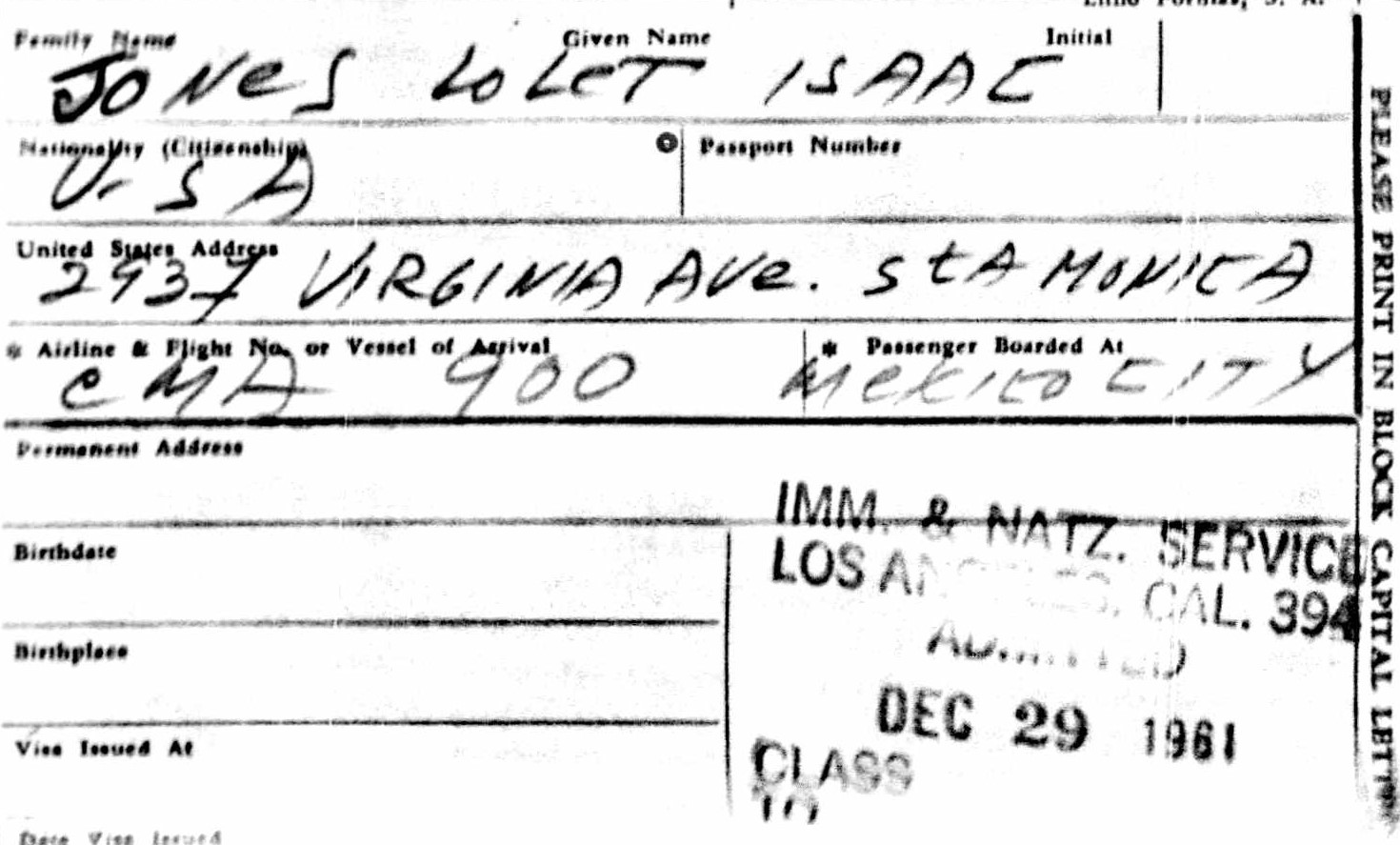
While he was enjoying a secret honeymoon with Inger in Mexico in late 1961, Ike Jones (born in Santa Monica in 1929) listed his home address as 2937 Virginia Avenue in Santa Monica. Though Inger didn't live in this home, she certainly spent time with Ike there during the early stages of their relationship. 

On his return trip from Mexico City, newlywed Ike Jones notes
the Virginia Ave address on this travel document.

My sad photo of Ike's home is all tree and shadows...

But this photo found online shows Ike's home in the proper light.

Ike Jones, at age 22, in 1952. He would meet Inger 8 years later.

Santa Monica Civic Auditorium

Who could forget Inger's mini-dress at the Academy Awards? The one that helped get miniskirts banned at the following year's Oscar ceremony? (You can read about it in this earlier post.) The ceremony took place at the Santa Monica Civic Auditorium on April 10, 1967.

Unfortunately, the area was unsightly due to construction when I took my photograph, but look how it shines with a happy, stunning Inger in front of it!

The auditorium in 2021

Inger in front of the auditorium in 1967

SMCA entrance now and with radiant Inger then


Inger (in color!) in front of the auditorium

The Holiday Theatre

Inger made her Broadway debut in a play fittingly titled "Debut" in February 1956. The play closed in a matter of days, but Inger had a sense of humor about the flop, telling Louella Parsons, “I was on Broadway for six months without actually being there. I opened in a play at the Holiday Theatre called Debut. It lasted four days and was a dismal failure. The theatre closed, but my name remained in lights on the marquee until the theatre reopened six months later." 

The Holiday Theatre was built in 1918 at 1567 Broadway. It is now the site of Dos Caminos, which you see directly behind the car. Below is a photo I took in 2021.

Site of the former Holiday Theatre where Inger's
name remained up in lights in 1956.

Inger on stage at the Holiday Theatre. Source: NYPL

Cort Theatre

"Roman Candle" premiered at the Cort Theatre on February 3, 1960. Like "Debut" four years earlier, "Roman Candle" closed after only 5 shows in 3 days, on February 6. Although disappointed, Inger joked about the failure, saying "At least I'm consistent!"

I visited the Cort when it was under construction in 2021. Built in 1928, the Cort is located at 138 W. 48th Street. 

An Inger fanatic under the Cort sign

Inger on stage at the Cort, 1960. Source: NYPL

D.C.

In 2022 I traveled to Washington, D.C. after making appointments to view Inger Stevens in Sweden (1965) and Strangers in Hiding (1954) in the Library of Congress archives. Watching two rare Inger appearances in the quiet, cold archives was a dream fulfilled. In fact, I was so wrapped up in the afterglow of seeing Inger footage that I failed to take photos of Katy Holstrum's D.C. once I emerged from the library.

In the archives with Inger

My sole reason for making a trip to D.C.

Inger in D.C. for The Farmer's Daughter


Thursday, December 1, 2022

Kraft Theater: Strangers In Hiding (1954)


Inger's star was on the rise as 1954 concluded. Inger had spent the last two years modeling, studying at the Actor's Studio, endlessly auditioning for roles, and working hard at summer stock. On August 9, 1954, after appearing in summer stock productions of "The Women" with Gypsy Rose Lee and "Glad Tidings" with Signe Hasso, Inger was introduced to television audiences in the "Sue Ellen" Studio One production. Three months later, Inger costarred with Paul Newman in a Goodyear Playhouse —the first of five TV gigs in five weeks! Between November 21 and December 29, Inger could be seen on Goodyear Playhouse, Armstrong Circle Theater, Mister Peepers, Danger, and Kraft Theatre. 

Inger was on a sensational streak and audiences took notice. She was noted as "the fast-rising Swedish discovery with the pensive face" by "Strangers in Hiding" critics. The Memphis Press predicted that she was "headed for Hollywood and a movie." Following "Thunder of Silence" with Paul Newman in November, Inger became an instant hit with the United States Navy Hospital Corpsmen. The men wrote her a letter praising her performance and beauty and crowned her "The Queen of Dorm 6." From New York City, Inger Stevens wrote a reply, "I have never been 'Sweetheart' or 'Queen' of anything in my whole life, but now I feel that I can die happy."


Inger's performance in "Thunder of Silence" earned her a notice in the December 6, 1954 issue of Time Magazine. Time defined Inger's beauty as "fragile and hauntingly attractive" and wrote, "her big-eyed  silences were more eloquent than all the speeches of her fellow actors."


Inger sudden success made it impossible to undergo a much-needed tonsillectomy, which would finally occur on February 11, 1955. The press assured that Inger was "taking her time about succumbing to the lure of Hollywood. Wants to make it via Broadway stage route and is perfectly willing to wait for a couple of years to do it, despite high-salary deals that have already been waved under her pretty nose." (Inger did not have to wait long. By the end of 1956, Inger had starred in an unfortunate Broadway flop entitled "Debut" and was in Hollywood filming her first movie role as Bing Crosby's love interest.)

Inger's final television role of 1954 was that of Kriste in Kraft Television Theatre's "Strangers in Hiding". Like so many of Inger's television parts, Kriste is a foreigner searching for the American dream while being misunderstood by the Americans she meets. The show costars Harold Lang, Bradford Dillman, and Doro Merande. The Minneapolis Star reported, "Dancer Harold Lang is well cast along with Inger Stevens in straight dramatic roles concerning an immigrant couple who hide out after their work permits expire so that their child may be born an American. Story is simply written and has several touching moments."

Inger Stevens in "Strangers in Hiding", 1954.


I was able to view "Strangers in Hiding" in the archives of the Library of Congress earlier this year and was struck by its similarity to Inger's Emmy-nominated role in "The Price of Tomatoes" eight years later.

Pregnant dancer Christe (Inger Stevens) and her dancer husband Mikail fail to get back on the bus when it stops in New Hampshire. Hoping to hide out until the birth of their baby in a few weeks, the couple sleep in a barn-turned-theater. They're happy to know their baby may be born an American citizen. Mikail dances on the deserted stage. Someone begins to open the door and the couple hides in the adjoining room. College flunkout Tom (Bradford Dillman) frequently sneaks in to play the piano when he's supposed to be studying at the library. Tom finds and pockets a locket by the piano, but he does not discover the couple. Tom's deceased father was a Hungarian violinist, and his American Aunt Ella (Doro Merande) is concerned that her nephew be a prominent real estate agent. 

When Mikail goes off to find food, Kriste encounters Tom. Terrified that he will report the couple to immigration, Kriste explains that her husband is German and she is Polish and that they did not have opportunities as dancers in Germany. They were able to make a good living as dancers in the United States until their six month work permit expired. Tom assures Kriste that his father was also an immigrant and he will keep their secret. Still, Kriste goes to sleep full of anxiety. 

The following morning, a gossiping friend visits Tom's house. She tells Aunt Ella about the fugitive couple rumored to be hiding in town. Ella is not surprised. "They're foreigners, you know...Nazis, communists. They're foreigners, aren't they?..If I had my way, they wouldn't let them in here in the first place." Soon after, Ella reminds Tom to be "just like the other real American boys." She becomes suspicious when she finds an inscribed locket in Tom's jacket pocket.

Back in the barn, Kriste is distraught over the missing locket, a good luck charm for the couple. Mikail assures her, "Our luck will not change." Tom returns to the barn with groceries and goodwill. He encourages the couple to dance and sing while he accompanies them on piano. At the market, Ella learns that her nephew has already purchased groceries and realizes he's feeding the fugitives. 

When Ella arrives at the barn, Kriste goes into labor. Instead of reporting the couple to the authorities, Aunt Ella shifts into maternal mode and protects Kriste and her unborn child. Ella confesses that she was never able to have a child of her own. To ensure that Kriste and her child, arriving prematurely, are healthy, Ella rides with Kriste in the ambulance to the hospital. When the local sheriff Sam and an immigration officer arrive at the hospital, Ella orders them to "go out and catch some criminals or take some change out of some parking meters." Kriste delivers a healthy baby boy ("We have an American son!") and her locket, which reads 'Have Faith' in German, is returned. 

As Inger's name appeared on the closing credits, the show's host announced:
We welcome lovely young Inger Stevens this evening in her first appearance in Kraft Television Theatre. Her theater experience includes Glad Tidings and The Women.
The themes of otherness and acceptance that Inger's Kriste and Doro's Ella, respectively, represent follow a common pattern in Inger's work. Inger's a Hungarian mother-to-be here, had been a Czechoslovakian teen in "Thunder of Silence", would be a new Swedish mother in "Burning for Burning", a pregnant Romanian widow in "Price of Tomatoes", and of course Swedish Katy in The Farmer's Daughter. Having moved to America just shy of ten years old, Inger knew what it felt to be non-native. Before settling in Kansas, the Stensland family lived in Manhattan where Inger noted:
I felt like a real foreigner...it was difficult adjusting to new people. My English was still broken and the atmosphere was so strange...I couldn't have [new clothes] for the realistic reasons that my serviceable Swedish clothes were worn ten times longer than they should have. I wallowed in self-pity to a revolting degree. I fit nowhere...I was...well...Swedish. I was embarrassed because I didn't look or act like anybody else...Everything was new...my stepmother, the country, and the language. Finding myself with a language barrier at such an impressionable age left me with a shyness I still haven't overcome. But I discovered that an easy way to make friends is to be a good listener.
Watching young Inger as Kriste in "Strangers in Hiding" on videotape in the archives of the Library of Congress was a rare delight. The thrill continued as I exited the library to the sight of Washington, D.C. monuments all around me. Katy Holstrum's monuments. Katy Holstrum's D.C. Being in the nation's capital where Inger (as Katy) walked, one could not help but to reflect on the compelling course of Inger's life—from a shy, fearful Swedish girl in New York City to the hopeful young actress on Kraft Television Theatre to the celebrated star of her own American television sitcom. 

Sources:
"Actress Finds Regular Work a Nuisance." Waco Tribune-Herald. December 25, 1954.
"From Sweden to Hollywood." St. Louis Globe-Democrat. February 15, 1959.
Chicago Tribune. December 25, 1954.
Memphis Press-Scimitar. December 29, 1954.
Minneapolis Star. December 29, 1954.
"TV Actress is Popular with USNH Corpsmen." Great Lakes Bulletin. December 30, 1954.
Time Magazine. December 6, 1954.
"Kraft Theatre: Strangers in Hiding." Library of Congress archives.


Thursday, October 20, 2022

The Farmer's Daughter: From 1947 Film to 1960s Television Series


On March 20, 1948, Loretta Young won the Best Actress Oscar for her performance in the 1947 comedy The Farmer's Daughter. The announcement was a surprise as Loretta's close friend Rosalind Russell was favored to win the honor. It would be the only Academy Award Loretta would take home—though she was nominated once more for the 1949 film Come to the Stable. Loretta would state that The Farmer's Daughter was her favorite movie "because that won me an Academy Award and that makes it special in my career." After an impressive film career that began in childhood, Loretta (truly an unsung female trailblazer of early television) found new success on her weekly television anthology The Loretta Young Show. It's only fitting that The Farmer's Daughter story should also transition to a small screen situational comedy for new audiences to enjoy. 

The Farmer's Daughter television series was produced by Screen Gems for ABC and ran for three seasons from 1963 to 1966. The Swedish-American maid named Katie Holstrum that Loretta portrayed now became a Swedish-American governess as the alternately spelled Katy Holstrum. The new Katy was played by Inger Stevens, who Screen Gems banked on matching "Loretta's Oscar-winning performance with an Emmy win." Inger only received an Emmy nomination for The Farmer's Daughter, but she did win the Golden Globe for the series.

Inger wins the Golden Globe.

Inger's television series was actually not the first remake of the 1947 film. A year before the television show premiered, Lee Remick starred in a special tv movie of The Farmer's Daughter in 1962. The Theatre 62 production was shot in color and costarred Peter Lawford, Charles Bickford, and Cornelia Otis Skinner. Reviewer Ben Gross wrote, "Although I didn't believe a word of it, I must admit that this did provide enjoyable escapist entertainment for the viewers...And if you accept the fact that it's no more than a corny political fairy tale, you must say that the TV adaptation was an expert one. The starry cast gave the show all it had. Lee was captivating and touching as Katrina, the farm lass."

The Farmer's Daughter (1962)

Prior to starring in her own television show, Inger had been freelancing as a television actress since 1954 and starring in motion pictures between 1957 and 1959. It was Inger's freelance work on shows such as The Twilight Zone, Bonanza, and Dick Powell Theatre that brought her high praise from critics. When asked what made her commit to playing Katy on television, Inger said that the series was "the first one that seemed good enough to take" and that production chief Bill Dozier "fed my ego to the bursting point...How could I turn it down after that?" 

Loretta as Katie and Inger as Katy

Inger was quick to point out that the series and her role were strikingly different from the previous versions. Inger said, “I have deliberately avoided both the screen and one-shot presentations of The Farmer’s Daughter. Truly, I’m quite an admirer of the work of both Miss Young and Miss Remick but I didn’t want to be accused of imitating either one, consciously or unconsciously. Besides, the elements are different. The Katy Holstrum I play isn’t a maid or servant as much. She is a governess, who is steeped in American history because she is a naturalized citizen."

Like Loretta, Inger was a consummate professional known for her charm and beauty in Hollywood. Both women knew that there was more to life than Hollywood and gave back to children in need; Loretta served on the board of the Daughters of Charity and Inger served on the Advisory Board of the Neuropsychiatric Institute at UCLA, both aiding children with disabilities. Loretta and Inger also shared an intense desire to maintain their private lives and protect the family members they loved from the press. Loretta kept the parentage of her adopted daughter Judy a secret—Judy was not adopted at all, but rather the daughter of Loretta and Clark Gable, which the press always suspected. The press also suspected that Inger was married to African American Ike Jones, but Inger refused to divulge any information. The marriage was not commonly known until Ike came forward to claim her estate following Inger's death in 1970.

Inger had a great advantage over Loretta when it came to Katy Holstrum's Swedish accent. Inger was born in Sweden and moved to America when she was just shy of 10 years old. As an adolescent living in New York then Kansas, Inger rid herself of her native accent. She re-learned it for her role in The Farmer's Daughter, remarking, "I'm beginning to think in Swedish again." (From personal experience, Inger felt it important that Katy slowly lose her Swedish accent as the show went on.)

Inger shooting external scenes in D.C.

The Farmer's Daughter was a moderate success, often receiving positive notices from critics. However, the show was never able to match the ratings and popularity of shows like The Beverly Hillbillies, Bonanza, The Andy Griffith Show, and Bewitched. In fact, Inger was concerned that the show "wouldn't last beyond the first 13 weeks...I must admit I'm proud we did it."

The Morning Call stated that the success of The Farmer's Daughter "can be credited to the charm of Inger, her accent, and her good looks. She’s a Loretta Young type with humor who will wear well over the years. That is, if Inger is interested…Sweetness with occasional fire will prevail on the Washington show and little change is in the wind."

The Farmer's Daughter (1947)

The Farmer's Daughter (1963-1966)

In the 1947 film, Katie Holstrum leaves the family farm to attend nursing school in Washington, D.C. Needing money, Katie takes a job as a maid in the household of Congressman Morley (Joseph Cotten) his political broker mother Agatha (Ethel Barrymore), and butler Joseph Clancey (Charles Bickford). When an unprincipled politician is chosen for Congress, Katie publicly disapproves at a meeting and ends up being elected herself. Katie and Congressman Morley fall in love and he supports her political career.

Like Loretta's Katie, Inger's Katy is a thoughtful, intelligent woman who speaks up with a dissenting voice and clear wisdom in the series' episodes. In the television series, Katy arrives in Washington, D.C., because she wants to travel to Congo to aid underprivileged children and needs Congressman Morley to approve the application. While she awaits application approval, Katy sees a great need for guidance and companionship for Glen's sons and takes a job as their governess. Soon, Katy feels that she belongs in the Morley household and can create great change, in the family dynamics and in Washington politics, as a governess. 

In the show, Katy provides many lessons to politicians, but she only campaigns for herself twice. In the season 1 episode "Katy and the Imagemaker", Katy abandons a bid for the State Assembly because the political team aspires to change everything about her. In season 2's "Katy's Campaign", Katy wants to be president of the Washington's Women's Club. Politically, Katy serves mostly as an advisor for Congressman Morley, often pointing out his missteps and broadening his belief system. The series very quickly focused on the romance between Glen and Katy, and they would be married in what would become a highly publicized episode in the final season.

Inger Stevens as Katy Holstrum

Inger was the star of the show, but the entire cast and their chemistry as a family unit contributed to the success. As Congressman Glen Morley, William Windom instantly sparked with Inger in their scenes together and the two made their love story believable and downright sexy, despite limitations with the censors. (I would be remiss if I didn't include here a link to the William Windom Tribute Site.) Actress Cathleen Nesbitt as Glen's mother Agatha Morley is a wonderful observer, instinctively mending miscommunications between the two leads. Mickey Sholdar and Rory O'Brien (as Glen's sons Steve and Danny) are some of the most talented, pleasant child actors to grace the small screen. Their roles add to the drama and believability of the scenes where other less skilled child actors might distract from the story. The show featured many notable guest stars throughout its three-year run, including: Charles Nelson Reilly, John Astin, Paul Lynde, Maureen McCormick, and Davy Jones.

The cast and crew expressed concerns that marrying the two main characters could spell ruin for the show, but also knew that an unmarried woman would only be allowed to live in a man's house for so long before censors urged a wedding. In November 1965, Katy married Congressman Morley in a beautiful color episode called "To Have and To Hold." You can read about the making of that special episode here on my blog and also watch it for yourself on Youtube.

Inger hoped that the marriage would bring new opportunities for her character.  While filming the wedding scene, she told reporters, "I hope we will be able to show that a married couple can be sophisticated—yes, and even sexy. After all, he found her attractive and appealing enough to marry her. Why should we try to hide their love just because they're married?"

Inger also used the marital status as a chance to update Katy's look, saying, "Katy wears more sophisticated clothes now and her hair is shorter and more stylish. I think that's only natural. It shows that he has an effect on her." 

Inger with William Windom for TV Guide

Inger with Mickey Sholdar and Rory O'Brien

The Farmer's Daughter ended after its third season, but it was not a sad occasion for Inger. She was eager to return to movies and said, "I enjoyed working on the series, but it was quite exhausting. For five days a week I had to be up at 5 a.m. and never got home before 8 p.m. Weekends were often spent studying my lines. I like doing movies presently because the roles are dramatic ones. It is the type of material with which I was involved before taking on the comedy role of Katy on television. Only by varying your roles can you learn more about your craft and sharpen your talents."

Following the end of The Farmer's Daughter, Inger starred in four westerns, four dramas, and one comedy. She would also film two made-for-television movies and was slated as the lead in the ABC crime drama The Most Deadly Game in the last year of her life. Loretta would end her weekly reign on television in 1963 just before The Farmer's Daughter premiered; at 73, she would return to star in the 1986 television movie Christmas Eve and snag a Golden Globe for her performance.

The 1947 movie and the 1963-66 series stand alone as two individual takes on a shared theme. The sitcom was able to borrow the film's characters and their motivations in order to move the storyline in new, unexpected directions. Whether you prefer maid-to-politician or governess-to-wife, the big and small screen versions of the Katie/Katy character exhibit an independent and charming woman encouraging positive change in the political and social worlds around her.

This post is part of Hometowns to Hollywood's Take Two Blogathon which focuses on Hollywood re-makes. Please read additional entries here.


Sources:
 “A Quiet Session with Inger Stevens.” Evening Sun. January 31, 1964. 
“Inger Stevens: Accent on Acting.” Star Gazette. September 8, 1962. 
“In Sweden with Inger.” The Morning Call. September 2, 1964. 
"Loretta Young Works for Charity." Tampa Bay Times. September 8, 1991.
"No Wedding Yet for Inger Stevens. Daily Press. August 9, 1964.
"The Farmer's Daughter is Pretty Bright." Call-Leader. September 15, 1966.